Connect HARPA to Make.com with webhooks
Send what HARPA reads or writes to Sheets, Slack or any app.
On this page
HARPA reads pages and writes with AI; Make.com passes the result on to Google Sheets, Slack, Notion or 1,000+ other apps. The bridge is a webhook: a URL that Make.com gives you and HARPA sends data to. The same steps work with Zapier, n8n or your own server.
# Create a webhook in Make.com
- In Make.com, create a scenario.
- Add the Webhooks app with the Custom webhook trigger, create a webhook and give it a name, like "From HARPA".
- Copy its address. It looks like
https://hook.eu1.make.com/….
Make.com learns the shape of your data from the first request it receives: start the scenario once in Make.com, then run your HARPA command or test from HARPA.
# Send a command's result with a Request step
A Request step sends data from any command to a URL.
- Open your command on the flow canvas: type / in the chat, hover the command, click Edit, then Canvas. New to commands? Start with Custom commands.
- Hover the line after the step whose result you want to send and click +. Pick Request.
- Paste the webhook address into url.
- Write what to send in body content, optional, with parameters in double curly brackets:
{
  "title": "{{title}}",
  "url": "{{url}}",
  "summary": "{{gpt}}"
}
- Click Save.
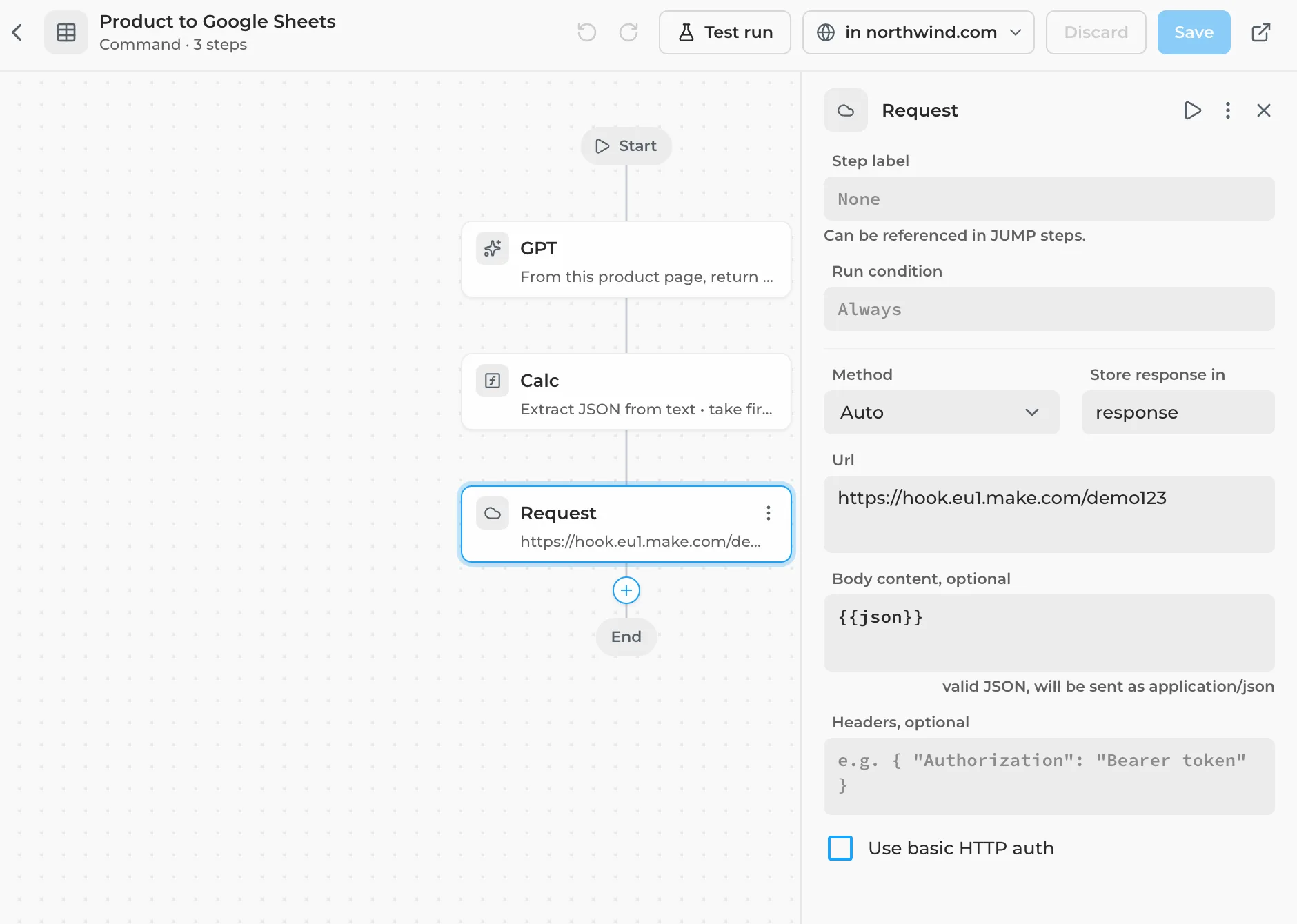
| Field | What it does |
|---|---|
| method | Auto sends POST when there's a body and GET when there isn't; or pick one |
| url | Where to send. Parameters work here too, like ?q={{p1}} |
| body content, optional | Text, a JSON object or a JSON list. The line under it says how it will be sent: as JSON or as plain text |
| headers, optional | A JSON object, like { "Authorization": "Bearer …" } |
| Use basic HTTP auth | Sends a username and a password with each request |
| store response in | The parameter that gets the reply: its status and body |
Every time the command runs, the step sends the data and shows the URL and the reply in the chat. Run the command once on a real page, then map the fields to the next module in Make.com, for example Google Sheets with Add a row.
# Send structured data, like a product row
To fill a sheet with one row per page, have AI answer in JSON and send that JSON as is.
- In the GPT step, ask for JSON, for example:
Read the product page and answer with JSON only, in a code block:
{ "product": "name", "price": 0, "description": "under 200 characters", "url": "{{url}}" }

Page: {{page}}
- Add a Calc step after it with the function Extract JSON from text, from
gpttojson. - In the Request step, set the body to
{{json}}alone. HARPA sends it as JSON, and Make.com seesproduct,price,descriptionandurlas separate fields.
The GPT step's Isolated option sends the prompt without the chat history: cheaper, and the answer stays on task.
# Add a webhook to any command
Built-in commands work the same way, like a summary you want in Notion or an article for WordPress.
- Type / in the chat, hover the built-in command and click Duplicate & edit (see Duplicate and edit a built-in command).
- Find the step that writes the result and note its parameter: the GPT step's store response in,
gptwhen empty. - Add a Request step after it and put that parameter in the body, like
{ "text": "{{article}}" }. - To send only when you choose, give the Request step a Run condition, such as
{{choice}} = webhook, and add that option to the command's Ask step.
# Send monitor alerts to a webhook
Monitors can send each check to a webhook without a command.
- Switch to Automate, open the monitor and click More settings.
- In the form, open More settings and click Actions.
- Turn on Webhook and paste the address into url. Click Test webhook to send a test event.
- Choose when to send under send on: every trigger, first trigger or task run (every check, the default), and an optional limit to, like once a day.
- Go back and click Save.
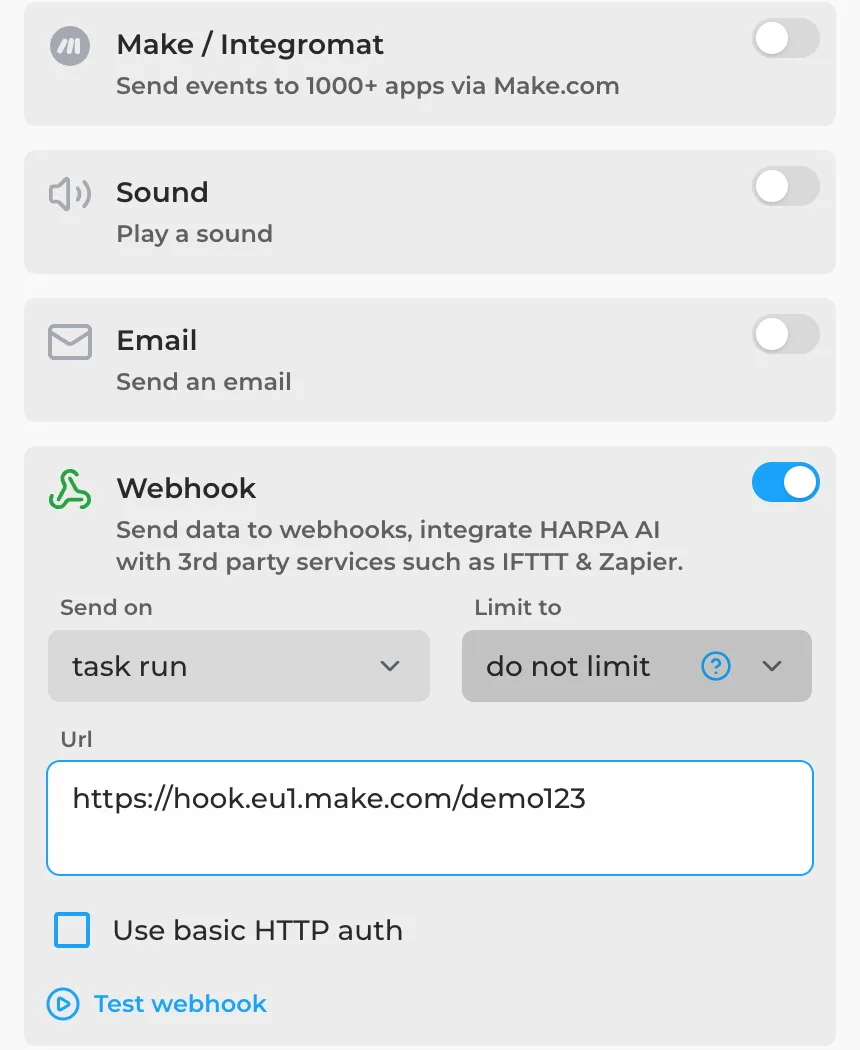
HARPA sends a JSON object with the monitor (task: name, url, domain), the latest check (record) and a flat csv
object ready for a sheet: taskName, url, date, time, value, status, triggered, info.
The Make / Integromat action next to it does the same through HARPA's own Make.com app: click INSTALL MAKE.COM APP, add its instant trigger to your scenario and paste the trigger's webhook address.
# Process many pages
- Open tabs: open the pages, then run the command on all of them with Run on tabs…. Each tab sends its own request: see Run a command on many tabs.
- A list of links: add a Loop over the list with a Navigate step to
{{item}}and a Command step that runs your Make.com command on each page. - On a schedule: run the command every day or on a trigger, see Run commands on a schedule or a trigger.
# Good to know
- Test any webhook first with a free URL from webhook.site: it shows exactly what HARPA sends.
- Scheduled automations run in your browser, only while it is open.
- A test run on the flow canvas is a real run: the Request step sends its data.
- AI steps use your model; on HARPA's cloud models they use cloud credits, see Cloud models and credits.